Celtic Clan:
A “clan” in a Celtic context refers to a kinship group, traditionally based on family and shared heritage, particularly in Scotland and Ireland.
The term, derived from the Gaelic word “clann” meaning “children,” signifies a community united by ties of blood, marriage, or allegiance to a common chief.
In Irish tradition, a Clan is a group of people who share a common surname and heritage, often tracing their lineage back to a common ancestor.
These groups were the fundamental social and political units in Gaelic Ireland.
Clans were not just blood relatives but also included clients and followers of the chief, all united under the clan name and loyalty.
While kinship was central, Clans were beyond blood relations.
Irish clans also included clients and followers who pledged their allegiance to the chief for protection or solidarity, even if they were not direct descendants.
The practice of fostering children within the clan helped solidify bonds and reinforce kinship ties.
Each Clan had its own chieftain and warriors.
Warriors were known for their aggression, ferocity, bravery, unique tactics in battle and their fierce fighting spirit.
They fought on foot, horseback, and in chariots, adapting their tactics to different situations.
These warriors, both men and women, were a formidable sight, frequently depicted with long hair, painted bodies, and sometimes going into battle naked.
Clans used distinctive war cries or slogans to identify themselves and boost morale.
Beyond warfare, they valued feats of strength, skill, and storytelling.
2.
Triskele / Triskelion:
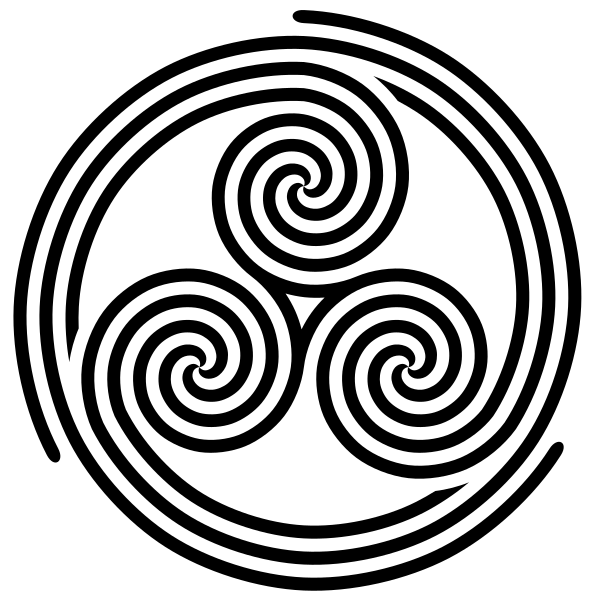
The Triskele, also known as the Triskelion, is a Celtic symbol representing the cyclical nature of life and the interconnectedness of various aspects of existence. It is often depicted as three interlocked spirals, and its symbolism revolves around the concept of three realms or stages: life, death, and rebirth; past, present, and future; or earth, water, and sky. The symbol embodies movement, progress, and the eternal flow of energy, suggesting that personal growth and spiritual evolution occur in cycles.
The Triskele and the Cycle of Life:
The Triskele’s three spirals are frequently interpreted as representing the stages of life, death, and rebirth.
It signifies that death is not an end, but rather a transition to a new beginning, mirroring the cyclical nature of existence.
This concept resonates with the Celtic belief in the interconnectedness of all things and the eternal flow of energy.
Three Realms of Existence:
The Triskele also symbolizes the three realms that were believed to constitute the world: the earth, the water, and the sky.
It emphasizes the interconnectedness of these realms and their influence on each other, suggesting that everything in the universe is part of a larger, unified system.
Motion and Progress:
The three arms of the Triskele are positioned in a way that suggests movement and progress, conveying the idea of constant change and evolution.
This aligns with the symbol’s association with personal growth and spiritual development, emphasizing that life is a journey of continuous learning and transformation.
Modern Interpretations:
In modern times, the Triskele continues to hold significance, representing personal growth, forward momentum, and the embrace of change.
It serves as a reminder that life is a series of cycles, and that embracing change is essential for personal and spiritual evolution.
Also known as a triple spiral, the Triskele is a prominent symbol that is found in ancient megalithic art.
3.
Newgrange
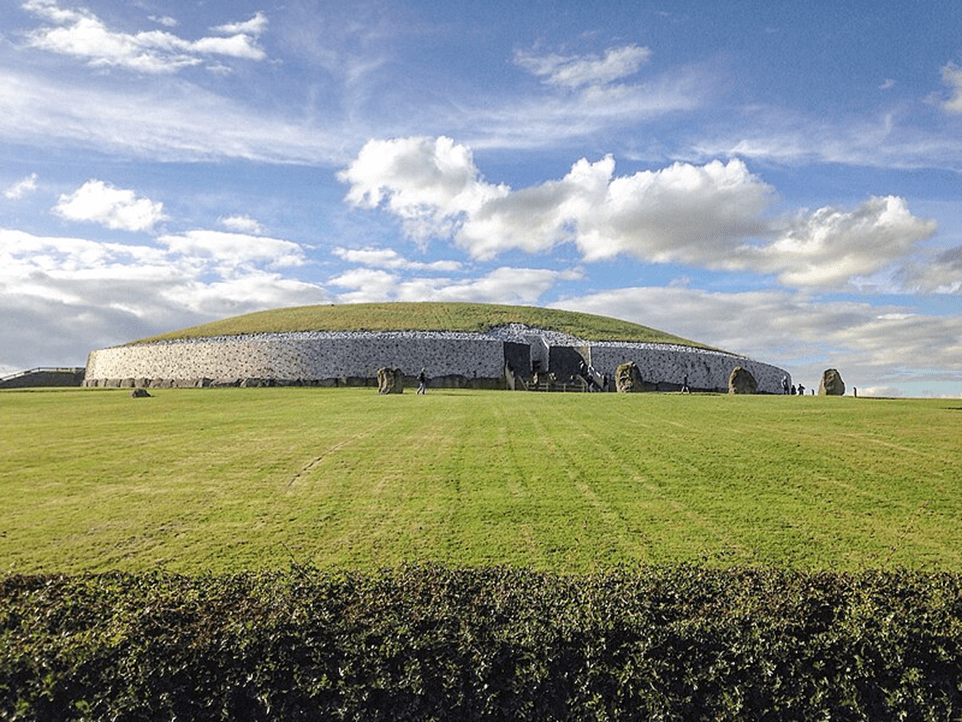
in County Meath, Ireland, located in a bend of the River Boyne, is Newgrange, also called the Boyne Valley tombs, an ancient monument complex and ritual landscape
The triple spiral design carved into the stone at the back of the chamber of the 5,000-year-old passage tomb at Newgrange, is a powerful symbol of the cyclical nature of existence, further emphasizing the symbol’s enduring relevance throughout history.
It is one of the world’s most important Neolithic landscapes, comprising at least ninety monuments including passage tombs, burial mounds, standing stones and enclosures.
The site is dominated by the passage tombs of Newgrange, Knowth, and Dowth built during the 32nd century BC.
Together these have the largest assemblage of megalithic art in Europe.
Constructed c. 3200 BCE, is one of the oldest surviving buildings in the world.
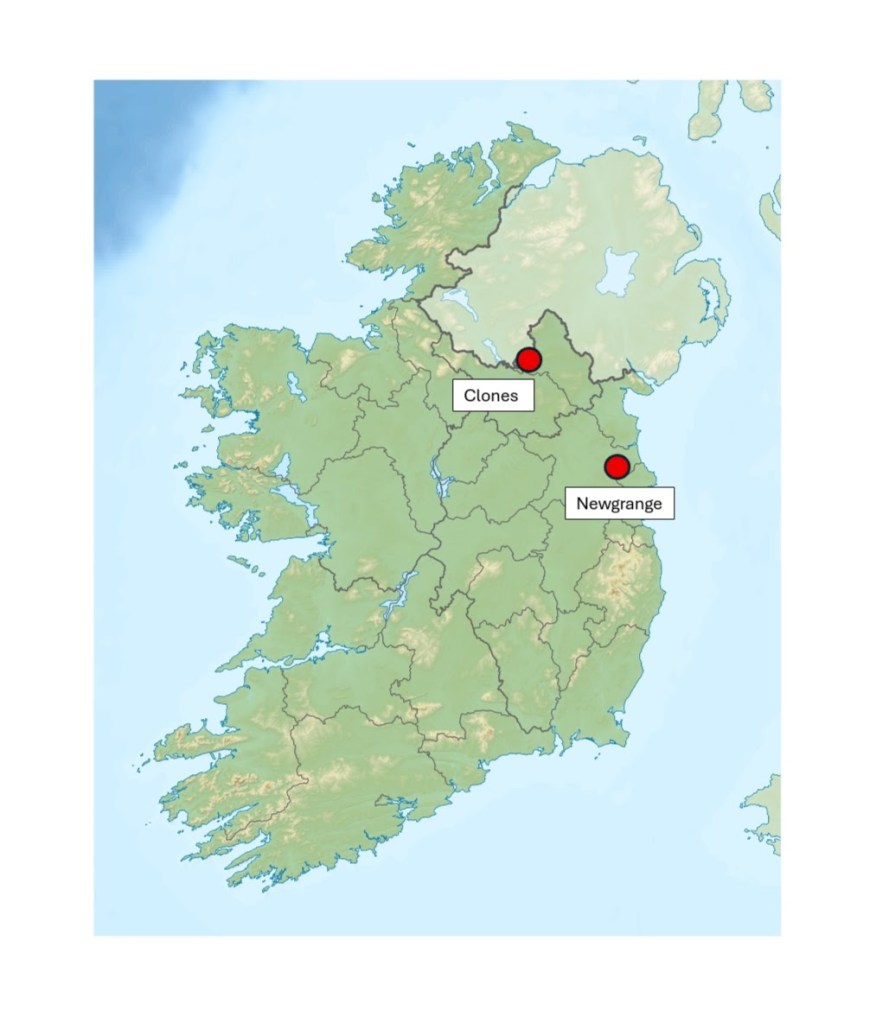
It is 94 km from our ancestral birth place of Clones, County Monaghan.
 Donohue-O'Donoghue
Leave a comment